
How to Choose a Melbourne Wedding Photographer: 10 Things I’d Check Before Booking
Based on first-hand experience photographing more than 200 weddings.
Choosing a wedding photographer looks deceptively simple.
You find a few photographers whose Instagram feeds look beautiful, compare their packages, read some reviews and work out who fits your budget.
But after photographing more than 200 weddings, I think that approach misses most of what actually determines whether you will be happy with your choice.
A wedding photographer does much more than create a few beautiful portraits.
They are one of the people you will spend the most time with on your wedding day. They influence how comfortable you feel in front of the camera, how smoothly your photography fits into the timeline, how family photographs are managed, what happens when Melbourne’s weather changes unexpectedly, and ultimately how the day is preserved for you afterwards.
And unlike most wedding decisions, you cannot test the finished product beforehand.
So if I were choosing a Melbourne wedding photographer today, these are the things I would look at.
TL;DR - How should you choose a Melbourne wedding photographer?
Look at several complete wedding galleries, not just Instagram.
Make sure the photographer consistently produces beautiful photographs across different lighting, weather and parts of a wedding day.
Speak to the actual person who will photograph your wedding.
Read detailed reviews about what they are like to work with.
Find out how they guide camera-shy couples, how they respond when a timeline runs late, and what they do before the wedding to prepare.
Then ask yourself one final question:
If my wedding was running 40 minutes late, it started raining and I was feeling stressed, would I trust this person standing beside me?
That tells you much more than follower counts ever will.
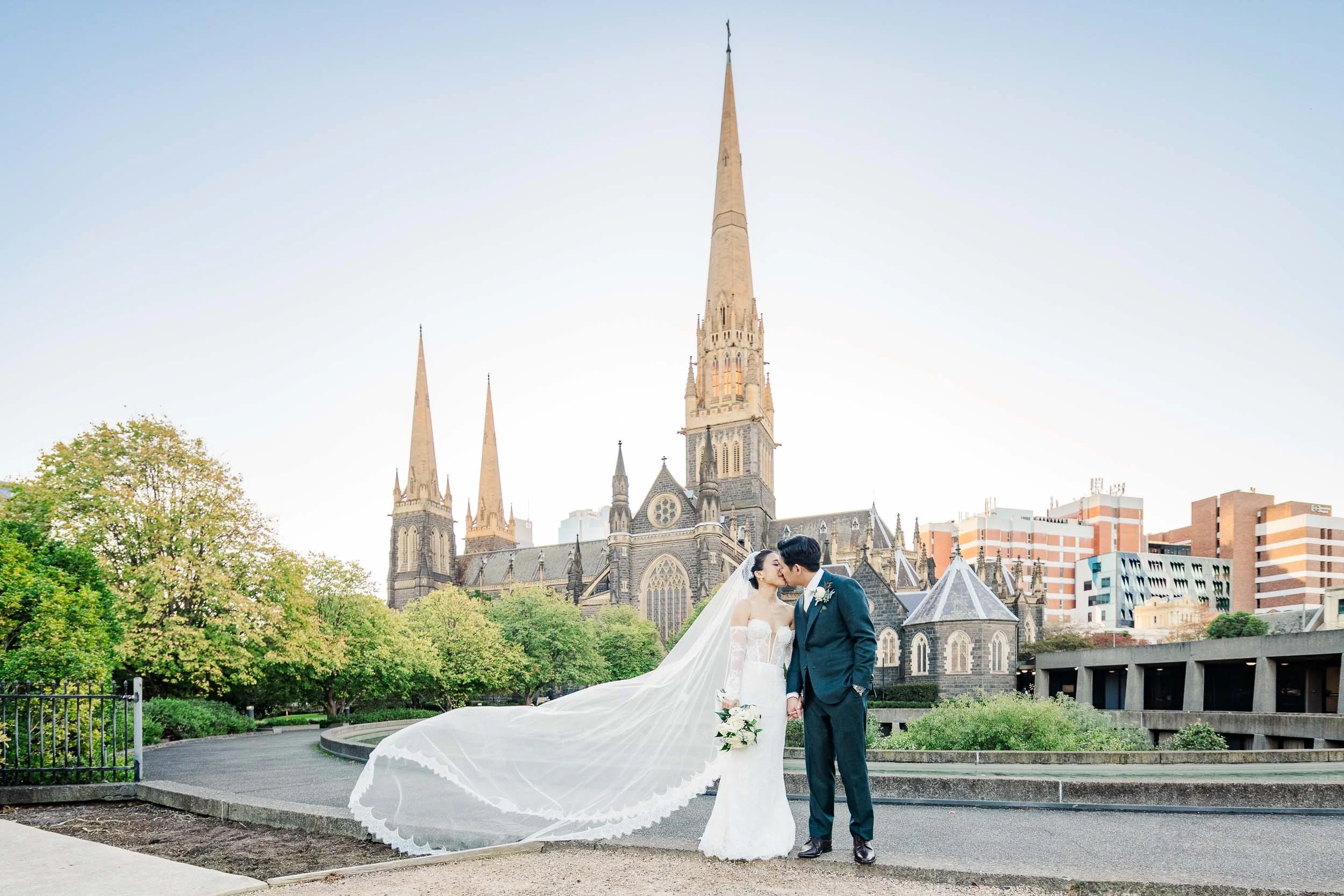
1. Don't choose a wedding photographer from Instagram alone
Instagram is useful for discovering photographers.
It is terrible for assessing consistency.
A photographer can choose their best photograph from one wedding, their best photograph from another, and their best photograph from another. Eventually you are looking at 30 exceptional photographs selected from tens of thousands.
That tells you what the photographer can produce.
It does not necessarily tell you what you are likely to receive.
This matters even more now that AI-generated imagery makes it increasingly easy to create convincing images that do not prove someone has actually photographed a real wedding.
I wouldn't automatically assume an unusual image is fake. But I also wouldn't treat a small collection of impressive images as sufficient evidence of professional wedding experience.
Ask to see two or three complete wedding galleries
Ideally, look at weddings with different conditions.
One might be a bright outdoor wedding.
Another might involve a dark church or indoor ceremony.
Another could have poor weather or a nighttime reception.
Then look at the whole thing.
Not just the hero portraits.
Look at:
getting ready
the ceremony
reactions from parents and guests
the first kiss
family photographs
bridal party photographs
details and styling
couple portraits
reception entrances
speeches
first dance
nighttime photography
candid moments between all of those things
A strong wedding gallery should help the couple remember not only what their wedding looked like, but how their wedding felt.
It should preserve the work they put into the day too: the venue, wedding dress, stationery, signage, flowers, table settings and all the details they may have spent months choosing.
And there should still be photographs of the couple that are beautiful enough that they would genuinely want to print them and put them on their walls.
My favourite test is emotional rather than technical
Scroll through a gallery and notice your own reaction.
Do you unknowingly smile?
Do the photographs make you feel something even though you don't know the people?
Technical basics still matter. Photographs should be in focus. Lighting should be intentional. Composition should be strong.
But technically perfect photographs that make you feel absolutely nothing aren't enough either.
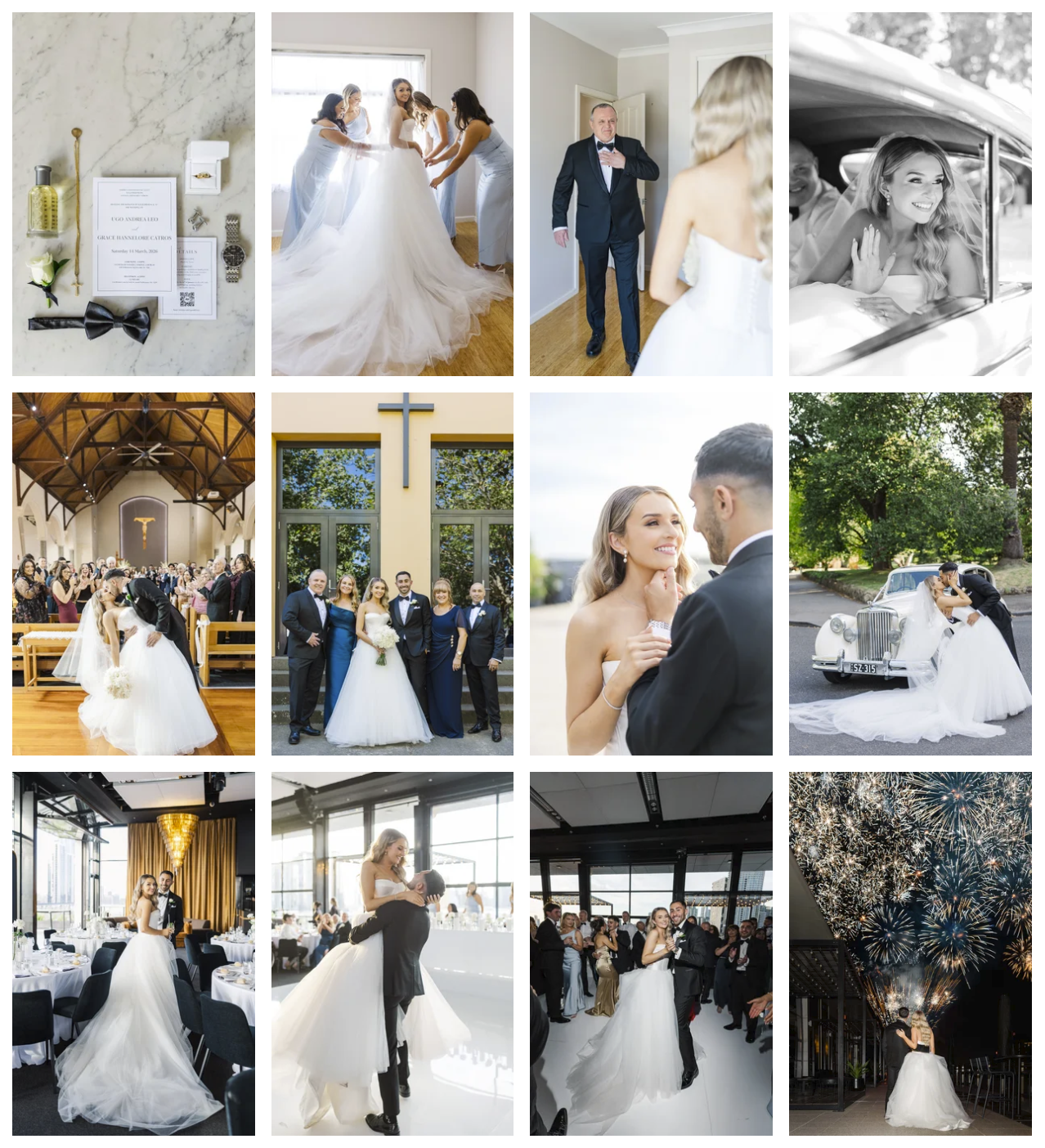
One wedding, one complete story. When comparing photographers, look for consistency across the entire day—not just the handful of images selected for Instagram.
2. Look for consistency, not one extraordinary photograph
This is one of the biggest differences I see between experienced photographers and photographers who are still developing their craft.
You should have a reasonably good idea what your own photographs will look like before your wedding happens.
Your finished gallery shouldn't feel like a surprise.
It should feel like:
“This is exactly as good as I expected.”
Look particularly closely at skin tones.
Do couples have natural-looking skin across daylight, indoor lighting, cloudy weather and nighttime reception photographs?
Does a white wedding dress remain reasonably natural throughout the gallery?
Does greenery suddenly become blue in one image and yellow in another?
Does every photograph appear to have a completely different filter?
Trendy colour grading can look fantastic today. The question is whether you still want your wedding photographs to look that way in 10 or 20 years.
If longevity matters to you, I would look for natural colours, believable skin tones and editing that supports the photograph rather than becoming the photograph.
And don't just inspect the photographer's favourite venue.
Look at what they produce in different Melbourne locations, seasons and weather.
Consistency under changing conditions is much harder than creating one beautiful photograph in perfect light.
3. “Natural wedding photography” doesn't necessarily mean no direction
This is probably one of the biggest misunderstandings I see.
Couples often tell me:
“We just want natural photos.”
But I don't think most couples actually mean:
“Please stand 10 metres away, say nothing and photograph whatever happens.”
What they usually mean is:
“I want photographs where I look like myself, feel comfortable and don't look awkward or over-posed.”
Those are very different things.
I've experienced this from the other side of the camera too.
When my wife and I hired a photographer ourselves, the approach was largely to stand back and allow us to “be natural”.
But afterwards, we didn't like how we looked in many of the photographs.
That experience reinforced something I had already begun learning through photographing other couples:
Natural-looking photographs often require good direction.
If someone who isn't accustomed to professional photographs has a camera pointed at them while the photographer stands silently, they often freeze.
Suddenly they are wondering:
Where do I put my hands?
Where should I look?
Am I smiling strangely?
What do we do next?
The photographer's silence hasn't made them more natural.
It has made them more self-conscious.
My approach is to guide when guidance helps, then disappear when it doesn't
If I can improve a portrait through posing, light, positioning or a small adjustment, I will.
If a genuine moment starts unfolding, I step back and let it happen.
One of my couples described this balance particularly well:
“Sherman has the right balance between stepping back to capture the important moments and then guiding us during the portrait and group shots.”
Another couple, Audrey and Fenly, jokingly described themselves as two “awkward potatoes” before their wedding. Afterwards, they said we somehow made them forget they were being photographed.
That is what I think many couples are actually searching for when they say they want “candid” photography:
to feel comfortable enough that the photographs look natural.
So ask your photographer:
“When do you give us direction, and when do you step back?”
Their answer will tell you much more than whether their website says “documentary”.
4. You are choosing a person, not just a photography style
Two photographers can have equally beautiful portfolios and create completely different experiences on your wedding day.
That matters because you may spend eight, ten or twelve hours with this person.
They may be in the room while you get dressed.
They will interact with your parents.
They may need to organise twenty family members.
They will be standing metres away during some of the most emotional moments of your life.
So talk to them.
Not just by email.
Have a proper conversation.
Do you feel comfortable talking to them?
Do they listen?
Do they understand what matters to the two of you?
Do their answers feel specific and confident, or vague and rehearsed?
Do they seem interested in your wedding, or mainly interested in closing the booking?
Some green flags I would look for
A professional photographer should be comfortable showing complete galleries and explaining exactly how they work.
They should be able to explain their backup plans.
They should ask thoughtful questions about you, your venue and your timeline.
They should be able to explain how they help people who don't normally enjoy being photographed.
And they shouldn't need to pressure you into making an immediate decision on the phone.
Some warning signs
I would be cautious if someone only shows styled shoots or highly curated highlights.
I would also be cautious if they avoid questions about backup equipment, emergencies or who will photograph the wedding.
Generic phrases such as “capturing authentic moments” don't tell you much unless the photographer can explain how they actually create that experience.
5. Find out exactly who will photograph your wedding
This question matters particularly when you're considering a larger photography studio or agency:
“Who is my exact photographer?”
Don't assume the photographer whose photograph you saw on Instagram is necessarily the person who will photograph you.
Some photography businesses operate as individual studios.
Others operate with a permanent team.
Others allocate freelance photographers to bookings.
None of those models is automatically good or bad.
A well-run studio with a small, tightly trained team, clear benchmarks and strong quality control can provide excellent results. It may also have greater redundancy if one photographer becomes unexpectedly unavailable.
The risk comes when you don't know what you're buying.
If another photographer will be assigned to your wedding, ask to see that person's portfolio.
Better still, ask to see complete galleries photographed by them.
Find out whether photographer substitutions can happen, under what circumstances, and how they are handled.
The person who created the image that convinced you to enquire may no longer even work with a particular studio.
You need to assess the photographer you are actually hiring—not simply the brand above their head.
For my own clients, this is one reason I make it clear that I personally photograph the wedding.
Knowing who will walk through the door matters.
6. Experience becomes most visible when something goes wrong
Wedding photography is relatively straightforward when you have perfect weather, perfect light, an empty location and a timeline running exactly to schedule.
Weddings rarely give you all four.
The most common problem I encounter is time.
Someone runs late during preparations.
Hair and makeup takes longer than expected.
Traffic delays the bridal party.
Family photographs take longer.
Portrait time gets compressed.
Then every delay starts affecting what comes afterwards.
This is where experience matters.
An inexperienced photographer may be thinking primarily about the photograph they are trying to create.
An experienced wedding photographer has to think about the entire situation.
They may simultaneously be:
managing the remaining time,
assessing the couple's stress level,
keeping the mood positive,
guiding a camera-shy couple,
finding usable light,
watching rapidly changing weather,
dealing with a crowded Melbourne location,
checking what needs to happen next,
positioning the couple,
communicating with other vendors,
and only then worrying about pressing the shutter.
The camera almost comes last.
Camera settings should already be instinctive.
The real job is managing everything happening around the camera.
And because couples naturally respond to the energy of the professionals around them, a photographer who becomes visibly stressed can make an already difficult situation feel worse.
This is why I would never judge experience simply by asking:
“How many years have you owned a camera?”
I'd ask:
“Tell me what you do when a wedding is running 30 minutes late.”
The answer is much more revealing.
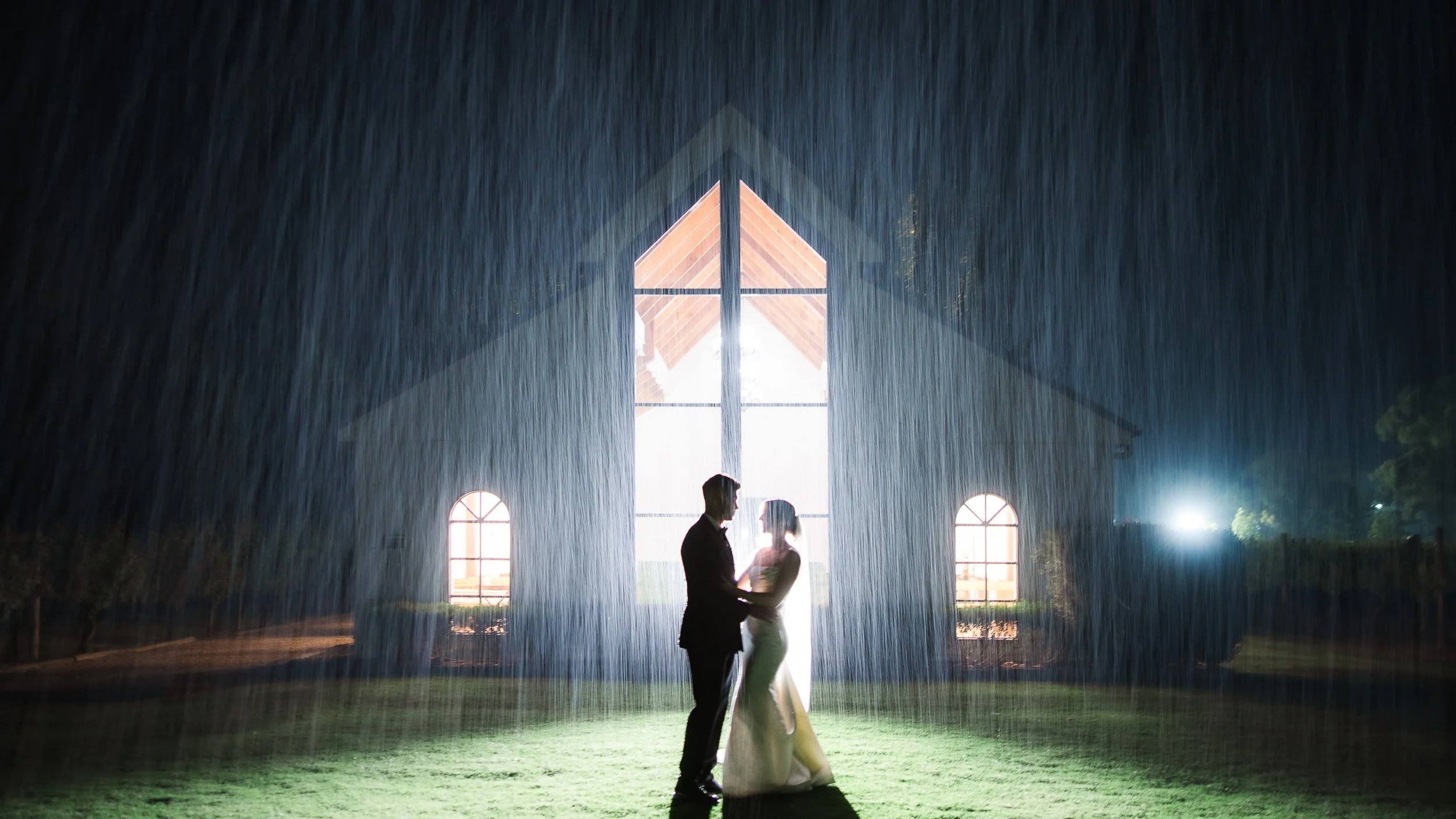
7. A good wedding photographer starts working before your wedding day
Photography shouldn't begin when somebody pulls a camera out of a bag.
Good preparation can prevent many of the problems photographers are later expected to solve.
For me, that starts with the timeline.
I want to identify unrealistic expectations before they become stressful realities.
That means allowing realistic travel time, creating breathing room between important parts of the day and building buffers so one small delay doesn't destroy everything afterwards.
I also like scouting locations when appropriate—sometimes earlier on the wedding day itself.
That tells me what is actually happening right now.
Where is the light?
How crowded is the location?
Is construction blocking something?
What is the weather doing?
Which areas are going to work?
Which ones aren't?
Then if portrait time suddenly gets cut in half, I'm not beginning from zero.
I already know where I want to go.
Louis and Bonnie mentioned this specifically after their wedding. They said I had gone “above and beyond” to scout their venue beforehand and that having plans ready made the wedding day feel seamless.
A pre-wedding session can also be much more than extra photographs
I think engagement or pre-wedding photography is one of the most useful ways to prepare camera-shy couples.
It allows us to get to know each other before the wedding.
They learn how I work.
We practise simple poses.
They can see how their hair and makeup photograph.
They have an opportunity to ask wedding questions without the pressure of the wedding day.
And they can create photographs to print or display at the wedding itself.
More importantly, by the time the actual wedding arrives, I am no longer a stranger pointing a camera at them.
Daniel and Rachel talked about how comfortable they felt working with us and how that helped keep their wedding relaxed even when the weather and original photography locations weren't cooperating.
That familiarity becomes extremely valuable on the wedding day.
8. Read reviews for patterns, not just five stars
Almost everyone you shortlist will probably have good reviews.
Don't stop at the rating.
Read what people actually say.
I would pay particular attention to repeated comments about:
feeling comfortable
communication
patience
direction and posing
timeline management
handling family
remaining calm
weather problems
adaptability
professionalism
delivery
whether guests enjoyed interacting with them
One review could be an unusually good experience.
Twenty people independently mentioning the same quality is a pattern.
For example, reviews of my work repeatedly mention couples initially being nervous or camera-shy, then feeling relaxed once we started photographing them.
Chelsea and Calvin said that even with a packed schedule and time pressures, nothing felt rushed.
Jonny and Olivia described experiencing sun and rain repeatedly throughout their wedding and said I handled the changing weather calmly.
CK and Ruby specifically mentioned receiving help not only themselves, but also with guiding their guests through photographs.
Those comments tell a prospective couple things my portfolio never could.
My portfolio can show you what photographs look like.
My clients are better qualified to tell you what I am like to work with.
That is what reviews are for.
9. Treat awards, publications and impressive package inclusions as secondary evidence
Awards can be meaningful.
Publications can be meaningful.
I've been fortunate enough to receive industry recognition myself.
But I would never choose a wedding photographer because of a badge alone.
Different competitions have different entry processes, judging standards and fees.
Likewise, not every appearance in a publication represents the same thing. Some editorial opportunities are independently selected; other media placements can be sponsored or paid.
So treat awards and publications as supporting evidence.
Not the foundation of your decision.
The same applies to package inclusions.
“Wedding album” tells you almost nothing
What size is it?
How many spreads?
What type of paper?
How is it bound?
What is the cover material?
Who manufactures it?
Is the design included?
“Large print” also tells you very little
How large?
On what paper?
Is it framed?
Mounted?
Matted?
Or is it a loose print delivered in a tube?
Compare what you are actually receiving rather than counting the number of bullet points on a package page.
Ten inexpensive inclusions aren't necessarily more valuable than three exceptional ones.
10. Don't make price your first filter
Photography is one of the unusual wedding purchases that can become more valuable with time.
You may care deeply about a photograph today.
Imagine what the same photograph might mean in 30 years.
Or after somebody in it is no longer here.
That doesn't mean the most expensive wedding photographer is automatically the best photographer for you.
They aren't.
And it doesn't mean you should spend money you genuinely cannot afford.
But I would be very cautious about choosing primarily because someone is cheaper.
You aren't only paying for someone to stand there with a camera for ten hours.
You are potentially paying for:
experience,
consistent photography,
consistent editing,
planning,
communication,
backup equipment,
contingency planning,
insurance,
reliable delivery,
quality printing and albums,
and somebody taking personal responsibility for the experience from beginning to end.
Most importantly, you're paying someone to photograph a live event that cannot simply be repeated if the result isn't what you expected.
If I had to reduce my wedding photography budget, I would rather reconsider extras than compromise on whether I trusted the person responsible for preserving the day.
Because once the wedding has happened, there isn't an opportunity to hire the photographer you wish you had chosen.
My hierarchy of evidence when choosing a wedding photographer
If I were assessing photographers myself, I would trust the evidence roughly in this order:
1. Several recent full wedding galleries
This tells me what they consistently deliver.
2. Detailed reviews from real couples
This tells me what they are actually like to work with.
3. A conversation with the photographer who will photograph me
This tells me whether I feel comfortable trusting them.
4. Their planning process and answers to difficult questions
This tells me how they operate when things aren't perfect.
5. Their curated website and Instagram portfolio
Useful for understanding style, but deliberately selective.
6. Awards, publications and follower counts
Nice supporting signals, but not sufficient proof on their own.
The questions I would ask before booking a Melbourne wedding photographer
If you've narrowed your choice down to two or three photographers, you don't need a 40-question interrogation.
I would ask these:
Can you show me two or three complete recent wedding galleries?
Will you personally be photographing our wedding?
How do you work with couples who feel awkward in front of the camera?
What do you do when a wedding timeline starts running late?
How do you prepare for our wedding before the day?
What happens if you are sick, your equipment fails or something unexpected happens?
Then pay attention not only to the answers, but how confidently and specifically they answer them.
Frequently asked questions about choosing a Melbourne wedding photographer
How many full wedding galleries should I ask to see?
I would look at two or three.
One gallery shows that a photographer can photograph one wedding well.
Several galleries under different lighting, locations and weather conditions tell you much more about consistency.
Does my photographer need to have photographed my venue before?
It can be useful, but I don't think it should be essential.
I'd rather hire an experienced photographer who knows how to scout, understand light and adapt quickly than choose someone purely because they have photographed the same venue 30 times.
A professional should be able to walk into an unfamiliar location, assess it and create strong photographs.
Should I choose a documentary wedding photographer if I want natural photos?
Not necessarily.
Ask how much direction they provide.
You may discover that what you actually want is a photographer who documents real moments but can also guide you when portraits, family photographs or difficult lighting require it.
Is an individual photographer better than a wedding photography agency?
Neither structure is automatically better.
The important question is whether you know exactly who will photograph you and whether you have seen that photographer's work.
A tightly managed studio with a permanent trained team can be excellent.
A studio where photographers are interchangeable may not suit a couple who values a personal relationship with the person photographing them.
Do wedding photography awards matter?
They can provide additional evidence of photographic ability, but I wouldn't make them a deciding factor.
Full galleries, real client experiences and your own interaction with the photographer tell you much more about what your wedding is likely to be like.
What is the most important thing when choosing a wedding photographer?
Trust.
Not blind trust—evidence-based trust.
You've seen complete galleries.
You've read what real clients experienced.
You've spoken to the person.
You understand how they work.
And you believe that if your wedding stops going according to plan, they will calmly help rather than become another problem you need to manage.
That's when I think you've found the right photographer.
One final thought
Your wedding photographer isn't simply somebody you hire to provide photographs afterwards.
They become part of the wedding while it is happening.
The right photographer should help you feel comfortable rather than self-conscious.
They should know when to guide you and when to leave a moment alone.
They should see problems developing before you need to worry about them.
And when you eventually receive the photographs, the gallery shouldn't merely show you what everything looked like.
It should help you remember how being there felt.
If that is the kind of wedding photography experience you're looking for, you can explore my approach to Melbourne wedding photography and my Signature Wedding Experience below.
About the author
Sherman Tan is the lead photographer behind Sherman Tan Studio, a Melbourne wedding photography studio known for calm guidance, natural skin tones, elegant composition and emotionally honest imagery. Having photographed more than 200 weddings in Australia and overseas, Sherman combines first-hand wedding experience with an architectural eye for light, space and composition.
Last reviewed: September 2026